Saying of the
Buddha |
Sayings of Jesus |
The Original
Jesus:
The Buddhist Sources of Christianity |
by Elmar
R. Gruber
& Holger Kersten |
| Man does not purify himself by washing as most people do in this world
Anyone who rejects any sin, larger and small, is a holy man because
he rejects sins (Ud 33:13).
Evil is done through the self; man defiles himself through the
self. Evil is made good through the self; man purifies himself
through the self (Dh 12:9).
|
Do not ye yet understand, that whatsoever entereth in at the mouth goeth
into the belly, and is cast out into the draught. But those
things which proceed out of the mouth came forth from the heart; and
they defile the man.
For out of the heart proceed evil thoughts, murders, adulteries,
fornications, thefts, false witness, blasphemies. These are
the things which defile a man; but to eat with unwashen hands defileth
not a man (Matthew 15:17-20). |
| Happily shall I live without possessions among those who possess much;
among possessors live without possessions.
Happily shall I live without struggling anxiously among the strivers
live without striving (GDh 167). |
How fortunate are the poor; they have God's kingdom. How fortunate
the hungry; they will be fed. How fortunate are those who are
crying; they will laugh (QS 8).
|
| Happily shall I live without hostility among the hostile; among the hostile
live without hostility (GDh 167).
O let us live in joy, free of hatred, among the spiteful; among
the spiteful let us live without hatred.
O let us live in joy, free of suffering, among those who suffer;
among those who are sore troubled let us live without suffering.
O let us live in joy, free of avarice, among those filled with
greed; among those who are avaricious let us live without greed.
O let us live in joy, we who are free of hindrances. Let
us be like the 'Radiant Ones' who are nurtured with love (Dh 15:1-4).
Whoever counters the malicious with malice can never be pure, but
he who feels no maliciousness pacifies those who hate. Hate
brings misery to humanity so the wise man knows no hatred (Ud 14:12). |
I am telling you, love your enemies, bless those who curse you, pray for
those who mistreat you.
If someone slaps you on the cheek, offer your other cheek as well.
If anyone grabs your coat, let him have your shirt as well
Give to anyone who asks, and if someone takes away your belongings,
do not ask to have them back.
As you want people to treat you, do the same to them.
|
| Hostility is never conquered by hostility in this world; hostility is
conquered by love. That is the Eternal Law (Dh 1:5).
Surmount hatred by not hating, surmount evil with good; surmount
greed through generosity, surmount lies with truth; speak what is
true, do not succumb to anger, give when you are asked.
Through those three steps you will come close to the gods (GDh
280-281).
Whosoever does no harm to living creatures, whosoever does not
kill or participate in killing, is to be called a holy man.
Whosoever is tolerant with the intolerant, whosoever patiently
tolerates punishment, and whosoever shows compassion to all creatures,
is to be called a holy man (Ud 33:45-46). |
If you love those who love you, what credit is that to you? Even
tax collectors love those who love them, do they not? And if
you embrace only your brothers, what more are you doing than others?
Doesn't everybody do that? If you lend to those from whom you
expect repayment, what credit is that to you? Even wrongdoers
lend to their kind because they expect to be repaid.
Instead, love your enemies, do good, and lend without expecting
anything in return. Your reward will be great, and you will
be children of God.
For he makes his sun rise on the evil and on the good; he sends
rain on the just and on the unjust (QS 9).
|
| Judge not the mistakes of others, neither what they do or leave undone,
but judge your own deeds, that just and the unjust (GDh 271-272). |
Don't judge and you won't be judged. For the standard you use (in
judging) will be the standard used against you (QS 10). |
| O Vasettha, those brahmins who know the three Vedas are just like a line
of blind men tied together where the first sees nothing, the middle
man nothing, and the last sees nothing (Tevijja-Sutta, Dighanikaya,
13:15). |
Can the blind lead the blind? Won't they both fall into a pit?
A student is not better than his teacher. It is enough for a
student to be like his teacher (QS 11). |
| The faults of others are more easily seen than one's own, but seeing one's
own failings is difficult. The failings of others are winnowed
like chaff in the wind, but one conceals one's own faults like a cheating
gambler (Dh 18:18).
The faults of the others are more easily seen than one's own.
They are more easily seen because they are winnowed like chaff in
the wind, but one's own failings are difficult to see. It
is like a cheat concealing his own dice while showing his opponent's,
drawing attention to the other's inadequacies and constantly thinking
of bringing accusations against him. Such a man is far from
seeing what is right, and very much worsens his unfortunate lot
(Ud 27:1). |
How can you look for the splinter in your brother's eye and not notice
the stick in your own eye? How can you say to your brother,
'Let me remove the splinter in your eye', when you do not see the
stick in your own eye? You hypocrite, first take the stick from
your own eye, and then you can see to remove the splinter that is
in your brother's eye (QS 12).
|
| No matter what a man does, whether his deeds serve virtue or vice, nothing
lacks importance. All actions bear a kind of fruit (Ud 9:8).
The bad person speaks falsely, chained by his words. He who
speaks ill and rejects what is truly just is not wise (Ud 8:9). |
A good tree does not bear rotten fruit; a rotten tree does not bear good
fruit. Are figs gathered form thorns, or grapes from thistles?
Every tree is known by its fruit. The good man produces
good things from his store of goods and treasures; and the evil
man evil things. For the mouth speaks from a full heart (QS
13). |
| Just as rain penetrates a badly-covered house, so passion enters a dispersed
mind. Just as rain does not penetrate a well-covered house,
so too does passion not enter a well-developed mind (Dh 1:13-14).
|
Why do you call me, 'Master, master', and not do what I say?
Everyone who hears my words and does them is like a man who built
a house on rock. The rain fell, a torrent broke against the
house, and it did not fall, for it had a rock foundation.
But everyone who hears my words and does not do them is like a
man who built a house on sand. The rain came, the torrent
broke against it, and it collapsed. The ruin of that house was great
(QS 14). |
| Those who aspire are ever striving; they do not stay in one place.
Like swans leaving a lake, they move from house to house.
The only source of refuge for those who do not accumulate possessions
and are careful about what they eat is unconditional freedom, knowing
as they do the void of transience. Their way is difficult
to follow like that of birds in the sky (Dh 7:2-3).
Whosoever has laid aside human ties, leaving behind the powers
of attraction of the gods, free of all bonds, that man I call holy
(Ud 33:52). |
When someone said to him, 'I will follow you wherever you go,' Jesus answered,
'Foxes have dens, and birds of the sky have nests, but the son of
man has nowhere to lay his head.'
When another said, 'Let me first go and bury my father,' Jesus
said, 'Leave the dead to bury their dead.'
Yet another said, 'I will follow you, sir, but first let me say
goodbye to my family.' Jesus said to him, 'No one who puts
his hand to the plow and then looks back is fit for the kingdom
of God' (QS 19). |
| People must store up reserves of faith since true merits cannot be taken
away and no one need fear thieves. Happy are the disciples who
have gained faith, and happy is the wise man when he meets such a
believer (Ud 10:11). |
Sell your possessions and give to charity (alms). Store up treasure
for yourselves in a heavenly account, where moths and rust do not
consume, and where thieves cannot break in and steal. For where
your treasure is, there your heart will also be (QS 40). |
| In this world the wise man holds onto faith and wisdom. Those are
his greatest treasures; all other riches he pushes aside (Ud 10:9). |
Seek after the treasure which does not perish, which endures in the place
where no moth comes near to devour, and no worm ravages (Thomas 76). |
| The heirs are quarrelling over his property, but the King's being accords
with his deeds. None of his possessions follow the dead man:
no sons, wives, money, or power. Long life is not achieved through
money, and old age is not frightened off by riches. Wisdom is
thus better than money since it leads to perfection (Rathapala-Sutta,
Majjhimanikaya 82).
'These children and these riches belong to me,' thought the fool,
anxiously. But since no one possesses even himself, what is
the point of 'my children and my riches'?
The law of humanity is that, even if people accumulate hundreds
and thousands of earthly goods, they nevertheless succumb to the
power of death. All stores are scattered; what was built is
torn down; everything that comes together must end in separation;
and life must terminate in death (Ud 1:20-22). |
Someone from the crowd said to him, 'Teacher, tell my brother to divide
the inheritance with me.' But he said to him, 'Sir, who made
me your judge or lawyer?' He told them a parable, saying, 'The
land of a rich man produced in abundance, and he thought to himself,
"What should I do, for I have nowhere to store my crops?"
Then he said, "I will do this. I will pull down my barns
and build larger ones, and there I will store all my grain and my
goods. And I will say to my soul, Soul you have ample goods
stored for many years. Take it easy. Eat, drink, and be
merry." But God said to him, "Foolish man? This
very night you will have to give back your soul, and the things you
produced, whose will they be?" That is what happens to
the one who stores up treasure for himself and is not rich in the
sight of God' (QS 38). |
| A wandering monk should neither despise what he has received nor should
he envy what others get. The envious monk does not achieve deep
contemplation (Dh 25:6).
The wise man does not make friends with the unbelieving, greedy,
slanderous or quarrelsome. The wise man avoids the evil (Ud
25:1).
|
Go. Look, I send you out as lambs among wolves.
Do not carry money, or bag, or sandals, or staff; and do not greet
anyone on the road.
Whatever house you enter, say, 'Peace be to this house!'
And if a child of peace is there, your greeting will be received.
But if not, let your peace return to you. And stay in the
same house, eating and drinking whatever they provide, for the worker
deserves his wages. Do not go from house to house.
And if you enter a town and they receive you, eat what is set before
you. Pay attention to the sick and say to them, 'God's kingdom
has come near to you.'
But if you enter a town and they do not receive you, as you leave,
shake the dust from your feet and say, 'Nevertheless, be sure of
this, the realm of God has come to you' (QS 20). |
| Whosoever is free of worries, holding onto truth and the Dharma, will
cross the sea of life, will put an end to suffering (Mahaparinibbanasutta
3:66).
It is difficult to follow the path of those who have accumulated
nothing and live from right nourishment, those whose only refuge
is unconditional freedom in recognition of the void of the transient.
Their path is like that of birds in the sky. It is difficult
to follow the path of those whose appetite is satisfied and are
not attached to consumption, those whose only refuge is unconditional
freedom in recognition of the void of the transient. Their
path is like that of birds in the sky (Dh 7:3-4).
|
I am telling you, do not worry about your life, what you will eat, or
about your body, what you will wear. Isn't life more than food,
and the body more than clothing?
Think of the ravens. They do not plant, harvest, or store
grain in barns, and God feeds them. Aren't you worth more
than the birds? Which of you can add a single day to your
life by worrying?
And why do you worry about clothing? Think of the way lilies
grow. They do not work or spin. But even Solomon in
all his splendor was not as magnificent. If God puts beautiful
clothes on the grass that is in the field today and tomorrow is
thrown into a furnace, won't he put clothes on you, faint hearts?
So don't worry, thinking, 'What will we eat?', or 'What will we
drink?', or 'What will we wear?' For everybody in the whole
world does that, and your father knows that you need these things.
Instead, make sure of his rule over you, and all these things will
be yours as well (QS 39). |
| When a mendicant monk, although still young, yokes himself to the Buddha's
teachings, the world is illuminated like the moon freed of clouds
(Dh 25:23). |
He who wishes to follow me must know himself and bear my yoke. |
| To anyone who leaves behind this world without having recognized his own
real world, that is of as little use as the Veda he has not studied
or some work he has avoided (Brihad-Aranyaka-Upanishad). |
Jesus said: He who would know everything, but fails to know himself
misses the knowledge of everything (Thomas 67). |
| Whosoever has heard the law of virtue and vice is as a man who has eyes
and carries a lamp, seeing everything. He will become completely
wise (Ud 22:4)
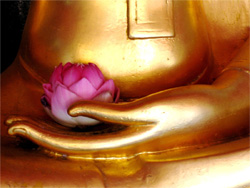
Just as a lotus blossom, scented and beautiful, can blossom on
a dunghill at the side of a road, so too radiates the wisdom of
the Buddha's pupils who have realized the Dharma, while normal mortals
are blind (GDh 303-304). |
No one lights a lamp and puts it under a bushel basket, but on a lampstand.
And those in the house see the light.
The lamp of the body is the eye. If your eye is good your
whole body will be full of light. But if it is bad your whole
body will be full of darkness. If the light in you is darkness,
how great is that darkness (QS 33). |
| The wise man should renounce the way of darkness and follow the way of
light (Dh 6:12).
This world is veiled in darkness; few there can see. Only
a few enter into the realm of bliss, just as only a few birds escape
the net (Dh 13:8). |
Because of that I say this: Whoever is emptied will be filled with light;
but whoever is divided will be filled with darkness (Thomas 61).
|
| Life is easy for someone who is shameless like a crow, slanderous and
presumptuous, boastful and corrupt.
Life is difficult for someone modest who always strives for purity,
detached and reticent, immaculate in life and clear in understanding
(Dh 18:10-11). |
Strive to enter by the narrow door, for many, I tell you, will try to
enter by it and will not be able. Once the owner of the house
has locked the door, you will stand outside, knock at the door, and
say, 'We ate and drank with you, and you taught in our streets.'
But he will say to you, 'I do not know where you are from. Get
away from me, all you unrighteous people' (QS 47). |
| One way leads to worldly gain and the other to Nirvana. Let the
mendicant monk, the Buddha's pupil, seek wisdom, not worldly honours
(Dh 5:16). |
No man can serve two masters. Either he hates the one and loves
the other, or he is loyal to one and despises the other. You
cannot serve God and wealth (Mammon) (QS 55). |
| (Buddha had withdrawn to a forest hut at Kosala in the Himalayas for solitary
reflection.) Then Mara, The Evil One, knew the thought that
had arisen in the Enlightened One, so he went to the Buddha: 'O Lord,
may the Enlightened One reign as King, may the Perfected One reign
with justice, without killing or ordering killings, without being
oppressive or serving oppression, without suffering form pain or causing
pain to others.' The Buddha answered: 'What doest thou have
in mind, O Evil One, that thou speakest thus with me?' Mara
responded: 'The Enlightened One, O Lord, has assumed the fourfold
might of miracles. If the Enlightened One so wished, he could
command the Himalayas, the king of mountains, to become gold, and
the mountain would become gold.' The Buddha turned him away:
'What would it help the wise man to own a mountain of gold or silver?
Whosoever has recognized the cause of suffering, how should he succumb
to desires?' Then replied Mara, the Evil One: 'The Enlightened
One knows me, the Perfected One knows me,' and, grieved and discontented,
he went away (Marasamyutta from the Samyuttanikaya II
10). |
Then Jesus was led into the wilderness by the spirit for trial by the
accuser. He fasted for forty days and was hungry. The
accuser said, 'If you are the son of God, tell this stone to become
bread.' But Jesus answered, 'It is written, "No one lives
by bread alone."' Then the accuser took him to Jerusalem
and placed him at the highest point of the temple and said to him,
'If you are the son of God, throw yourself down, for it is written,
"He will command his angels to protect you", and "They
will carry you with their hands so that your foot will not strike
a stone."' But Jesus answered him, 'It is written, "You
shall not put the lord your God to the test."' Then the
accuser took him to a very high mountain and showed him all the kingdoms
of the world and their splendor, and he said to him, 'All these I
will give you if you will do obeisance and reverence me.' But
Jesus answered him, 'It is written, "You shall reverence the
lord your God and serve him alone."' Then the accuser left
him (QS 6).
|
| The Evil One spent six difficult years, constantly following the Bohdisattva,
always looking for, seeking, an opportunity to get the better of him,
but he never succeeded. When he did get a chance, he had to
leave frustrated and wrathful (Lalitavistara XVIII). |
And when the devil had ended all the temptation, he departed from him
for a season (Luke 4:13).
|
| Better than reigning supreme over the earth, better than ruling heaven,
better than dominating all worlds, is the reward of the sotopatti
way (Dh 13:12).
|
For what is a man advantaged, if he gain the whole world, and lose himself,
or be cast away (Luke 9:25).
For What is a man profited, if he shall gain the whole world, and
lose his own soul? (Matthew 16:26; Mark 8:36). |
| You fool! Of what use are your long locks? Of what use your
clothing of hides? Within yourself darkness is at home.
Only outwardly you clean yourself (Ud 33:8).
Of what use is your matted hair, O fool! Of what use your
clothes made of animal hides? Within yourself is a jungle,
but outwardly you adorn yourself (Dh 26:12). |
Shame on you Pharisees! For you clean the outside of the cup and
the dish, but inside you are full of greed and incontinence.
Foolish Pharisees! Clean the inside and the outside will also
be clean. Shame on you Pharisees! for you love the front
seats in the assemblies and greetings in the marketplaces. Shame
on you! for you are like graves, outwardly beautiful, but full
of pollution inside (QS 34). |
| The blind saw and the deaf could hear...The ill were healed. The
hunger and thirst of the deprived were stilled. Drunkenness
was taken away from the drunken. The mad regained reason.
The blind could see again, and the deaf hear (Lalitavistara
VII). |
Jesus said, 'Go and tell John what you hear and see: the blind recover
their sight, the lame walk, lepers are cleansed, the deaf hear, the
dead are raised, and the poor are given good news' (QS 16). |
Jesus,
Buddha Krishna Lao Tzu:
The Parallel Sayings |
by Richard Hooper |
| The blind saw and the deaf could hear...The ill were healed. The
hunger and thirst of the deprived were stilled. Drunkenness
was taken away from the drunken. The mad regained reason.
The blind could see again, and the deaf hear (Lalitavistara
VII). |
Jesus said, 'Go and tell John what you hear and see: the blind recover
their sight, the lame walk, lepers are cleansed, the deaf hear, the
dead are raised, and the poor are given good news' (QS 16). |
| The Way is complete in itself. Like the vastness of space, it lacks nothing, and has nothing in excess. - The Third Chinese Patriarch of Zen |
The Kingdom is spread out over the whole world, and people do not see it. - The Gospel of Matthew |
| Listen avidly to and cherish the Way which is called mighty. - The Sutra of Forty-Two Sections |
Ask, and it will be given you. Seek, and you will find. Knock, and the door will be opened. - The Gospel of Matthew |
| Only those with a pure heart, and with a single purpose, will be able to understand the most supreme Way. - The Kevaddha Sutta |
Judas asked, "How does one begin to walk the Way?" Jesus answered, "By developing love and compassion." - The Dialogue of the Savior |
| To begin the journey in the Way...first, set yourself straight. You are your only master. - The Dhammapada |
The Kingdom is not coming with signs to be observed. The Kingdom of God is within you. - The Gospel of Luke |
| The Way cannot be found in words. Nothing on earth can define it. If one loses sight of it, even for an instant, it may be lost forever. - The Buddha |
This Way you have found, even the angels do not know it. It comes from the unity of the Father and the Son, for they are One. Travel this path you have found. - The Dialogue of the Savior |
| Universal Mind exists like a vast and boundless ocean. Waves disturb its surface, but beneath, all is calm and eternallly unmoved. Having no personality, all things exist in it. But due to the disturbance upon its surface, it became an actor playing many parts. - The Lankavatara Sutra |
In the beginning was the Word, and the Word was with God, and the Word was God. He was in the beginning with God; all things through Him came into being. In Him was Life, and the Life became the light of men. And the Light appears in the darkness, and the darkness has not apprehended it. - The Gospel of John |
| I am not to be perceived by means of any visible form, Nor sought after by means of any audible sound; Whoever walks in the way of iniquity cannot perceive the blessedness of the Lord Boddha - The Diamond Sutra |
Before that which is visible came into being, all existed in Him, He embraces all, nothing embraces Him. - The Sophia of Jesus Christ |
| Mark well how varied are the aspects of the Immovable One, and know that the First Realty is unmoveable. Only when this insight is attained will the true workings of such-ness be understood. - A Manual on Zen Buddhism |
I Am the one who is with you always. I am the Father, the Mother, the Son. I cannot be defiled or corrupted. I have come to teach you those things that are, and those things that will be, so that through this revelation you will perceive the perfection of humanity. - The Apocryphon of John |
| In the sky, there is no distinction of east and west; people create distinctions out of their own minds and then believe them to be true. - The Buddha |
Original Man had a single mind within him. - The Dialogue of the Savior |
| Do not dwell in the past, do not dream of the future, concentrate the mind on the present moment. - The Buddha |
Be aware of which is right in front of you; then you will be able to grasp what is out of your sight. For there is nothing hidden that will not be known. - The Gospel of Thomas |
| What we are today has come from yesterday's thoughts. Our present thoughts build our life of tomorrow: Our life is the creation of our mind. - The Dhammapada |
I (Mary Magdalene) saw the Lord in a vision and I said to him, "Lord, I saw you in a vision." He answered me, saying "You are blessed because your vision of Me did not falter. Where the mind is, there is your treasure." - The Gospel of Mary (Magdalene) |
| The discriminating mind is a dance and a magician with the objective world ass his stage. Intuitive-mind is the wise jester who travels with the magician and reflects upon his emptiness and transiency. - The Lankavatara Sutra |
I said to Him, "Lord, what allows one to see a vision? Do we see it with the soul or with the spirit?" The Lord answered and said to me, "One sees not through the soul or the spirit, but through the Mind-which is between these two." - The Gospel of Mary (Magdalene) |
| He who experiences the unity of life sees his own Self in all beings, and all beings in his own Self, and looks on everything with an impartial eye. - The Buddha |
You recognized Spirit and became Spirit. You saw Christ, and you became Christ. You saw the Father and you will become the Father. And yet, if you do not recognize these things as your Self, you will not become what you see. But if you recognize your Self, that which you see, you will become. - The Gospel of Philip |
| People suppose that their wealth and families belong to them. But nothing to us, and having such thoughts only leads to suffering. - The Dhammapada |
There was a man of great wealth who said to himself: "I will fill my storehouses with all my produce, and then I will be secure." This is what man thought, but that very night be died. Those who have ears to hear, should hear. - The Gospel of Thomas |
| Like a bird which is content wherever it goes - its wings its only burden, the monk is content with one set of robes, and a bowl for his daily food. Wherever he goes, he takes only the bare necessities. - The Kevaddha Sutta |
Sending out his disciples, Jesus said, "Tale no gold, nor silver, nor sopper in your belts, no bag for your journey, nor two tunics, nor sandals, nor a staff; for the laborer deserves his food. - The Gospel of Matthew, Mark and Luke |
| One buries treasure believing that there will be need of it in the future...But acting with charity and goodness, the selfcontrolled man stores up hidden treasure no thief can steal. - Khuddaka Patha |
Do not accumulate earthly possessions, which moths and rust can destroy, and which robbers can steal. Rather, store up heavenly treasures which cannot be destroyed or stolen. For wherever you heart is, there is your treasure as well. - The Gospels of Matthew, Luke and Thomas |
| One road leads to wealth, the other to Nirvana. Knowing this, the monk will seek to seperate himself from the world. - The Dhammapada |
It is easier for a camel to go through the eye of a needle than for a rich man to enter the kingdom of God. - The Gospels of Matthew, Mark and Luke |
| Recognize those things that lead you forward, and those things that hold yo uback. Choose the way that leads to wisdom. - The Buddha |
Truth finds those who are virtuous and wise. - The Dialogue of the Savior |
| Those who read many scriptures, but who fail to practice what they contain, are like someone counting someone else's cows. They gain nothing for themselves. - The Dhammapada |
Those who are wise are like the fisherman who caught many fish. He chose the largest fish to keep, and threw the small fish back into the sea. - The Gospel of Thomas |
| When one transcends intertia through diligent practive, he gains wisdom and his suffering ceases. - The Dhammapada |
How fortunate is the wise man who seeks after truth. When he finds it, no one can disturb his peace. - The Book of Thomas the Contender |
| The wise man who sees the world as an illusion does not act as if it is real. Therefore he does not suffer. - The Buddha |
Understand what is here and now, and you also understand the mysteries. - The Gospel of Thomas and Kephalaia LXV |
| Being immersed in the highest state of consciousness, the disciple's heart is connected to compassion. He sees himself in all beings, and is free from negative feelings towards others. - Doctinal formulas |
Love your neighbor as yourself. - The Gospels of Matthew, Mark and Luke |
| With generosity and kind words, always doing to others what is good, he treats all people the same. His compassion for the world is like the hub that makes the wheel turn round. - Anguttara Nikyaya |
You have heard it said that, "You should love your neighbor and hate your enemy." But I say to you, Love your enemies and pray for thosewho persecute you, so that you might be children of your Father who is in heaven. - The Gospels of Matthew and Luke |
| If you do not take care of one another, who else will do so? Those who would care of me, should care for those who are sick. - The Buddha |
For I was hungry and you gave me food, I was thirsty and you gave me drink, I was a stranger and you welcomed me, I was naked and you clothed me, I was sick and you visited me, I was in prison and you came to me...what you did to one of the least of these, my brethren, you did also to me. - The Gospel of Matthew |
| Everyone fears violence, jusy as they fear death. Likewise, all people love life. So see yourself in others. Then it is not possible to hurt anyone. Then you can do no harm. - The Buddha |
Love your enemies. Pray for those who persecute you. You will then become children of your Father in heaven. Blessed are the merciful, for they will receive mercy. - The Gospels of Matthew and Luke |
| No monk is a true monk who has not first purified the mind. Those who were the saffron robes, but lack the honesty and self-control are not worthy of wearing the saffron robes. - The Dhammapada |
Be careful that your spiritual practice is not public, so that others know that you are spiritual. When you give to charity, do not announce it like the hypocrites do, so that others may praise them. They already have their reward. Do not let your left hand know what your right hand is doing. Do charity in secret, and your Father will reward you in secret. - The Gospels of Matthew and Luke |
| Those who have heard my word but not practiced it, life after life, will descend into the lowest hell. - The Lotus of the True Law |
Not everyone who says to me "Lord,Lord" will be saved, but only those who do works of righteousness. - The Gospels of the Eqyptians, Matthew and Luke |
| Those monks are immature who seek prestige, doing their best to gain influence and admiration...these monks who are puffed up and boastful, insisting on their own point of view, only increase their pride and passion. - Kevaddha Sutta |
Keep away from those who consider themselves to be learned, and like to parade around in their fine vestments, and who love to be noticed and honored in public - those who take the seats and honor in the synagogues, and at feasts. These hypocrites steal from widows even while they say long prayers. The judgment which comes upon them will be great. - The Gospels of Mark, Matthew and Luke |
| Fools of poor understanding have themselves fo their greatest enemies, for they do evil deeds which bear bitter fruit. - The Dhammapada |
Learn to hate that hypocrisy, which is produced by evil intentions. Hypocrisy never comes close to truth. - The Apocryphon of James |
| The wise person who conquers lethargy through practice and sincerity, trancends suffering and reaches the mountain top, which is wisdom. - The Dhammapada |
If you knew of to suffer, you would have the power not to suffer. Know how to suffer, then you will have power not to suffer. - The Hymm of Jesus from The Acts of John |
| If the mind is serene at the time of death, some beings rise and attain the heaven-world. - A Sermon to Monks |
Blessed are those who are persecuted; they will rest in the light. - The (Greek) Gospel of Thomas |
| Of those things that come and go, which are affected by suffering, change and decay, one can not say that this is the Self. - The Buddha |
I (John) saw his suffering and could not bear it. I turned away and wept. But the Lord stood before me in a vision of light and said, "John, those below us see me as being crucified, pierced, and given bitterness to drink. But hear me-the one who stands before you- and hear what I say...it was not I who was on the cross. - The Acts of John |
| Those who are selfless rejoice in both this world and the next. - The Dhammapada |
My true being is not the body that surrounds me. Therefore, I did not suffer, nor was I in anguish at any time. These people did not harm me. Rather, the rulers of the universe destroyed my body, and it is fitting that they should have done so. - The (First) Apocalypse of James |
| As the echo belongs to the sound, and the shadow to the sunstanct, so misery will overtake the evil-doer without fail. - Three Sermons |
Be merciful that you may obtain mercy; forgive that you may be forgiven. What you do is what will be done to you. As you give, so it will be given to you; as you judge, so you will be judged; as you serve, so will service be done to you; with what you measure out, it will be measured out to you in return. - Agrapha, and the Gospels of Matthre and Luke |
| &If you harm one who is innocent, the harm comes back to you like dust thrown into the wind. - The Dhammapada |
Judge not, that you not be judged. For with the judgment you pronounce, you will be judged. - The Gospels of Matthew and Luke |
| If an evil person criticizes someone who is virtuous, it is like spitting at the sky. The spit doesn't dirty the sky, but returns to pollute the person who spits. - Three Sermons |
Agree with your adversary quickly while you are on the way with him, lest your adversary deliver you to the judge, and the judge deliver you to his officer, and you be cast into prison. Amen, I say unto you, you will not come forth from there until you have paid the last farthing. - The Gospels of Matthew and Luke |
| Misfortune will be the end of those who practice little virtue. They will be tormented in the six worlds. - The Lotus of the True Law |
The soul will be punished...according to transgressions of which it is guilty...then the Virgin of light will bind that soul and hand it over to one of her judges to have it cast into a body which is appropriate for its crimes. - The Pistis Sophia |
| Not in the sky, nor in the midst of the ocean, nor deep in the mountain, nowhere can you hide from your own death. - The Dhammapada |
When what animates a person is removed, that person is called dead, and when what is alive leaves what is dead, that which is alive will be summoned. - Dialog of the Savior |
| Death is not to be feared so much by one who has lived wisely. - The Buddha |
Do not run from death, but seek it out. For when you look at death closely you will discover within your salvation. For no one who fears death will be saved from it. Scorn death and take thought of Life! - The Apocryphon of James |
| Those who understand the teaching of the dharma transcend death...Death takes those who pursue pleasure, but those with wisdom go beyond. - The Dhammapada |
The souls of every human generation will die. When these people, however, have completed the time of the kingdom and the spirit leaves them, their bodies will die but their souls will be alive, and they will be taken up. - The Gospel of Judas |
| The wise, his fetters burst, the urge for further life exhausted, no more the prospect of rebirth for him at death, but full release. - The Sanskrit Dharmapada |
I have overcome the world. Do not let the world overcome you. I have become free of the world. You too become free of it. - The Gospel of the Savior |
| He will go to the other shore and stand on dry land is he has realized liberation and hidden knowledge in this life. - Catukka Nipata Pali |
Everyone who has heard and learned from the Father, comes to Me. - The Gospel of John |
| If the eye never sleps, all dreams will naturally cease. If the mind makes no discriminations, the ten thousand things are of a single essence. - The Buddha | When all the trials of life are ended, and one awakens, he sees nothing like it was before. Such a path is attained by those who have ended ignorance, letting it go as if it was nothing more than a dream. No longer do they value those things of the material world. They lleave ignorance behind like sleep. - The Gospel of Truth |
| The heroic sage who has broken every bond, has achieved peace, rid of all defilements, this one is enlightened, no longer trouble with doubts, and has arrived at the end of the action, released from the clinging that brings destruction. - The Itivuttaka sutte |
Because you have renounced all, and have endured all sufferings, and because of your rebirth from one body to the next, you have become pure light. You will ascend and be king of the kingdom of Light. - The Pistis Sophia - |